Wednesday, May 2, 2012

The simple geometry of sun, moon, and star paths

How to determine the sun, moon, and stars' path across the sky at any latitude, and at any time of the year.


A challenging geometric problem: Derive the sun path (or day arc of the sun), the sun's trajectory in the sky, given a latitude, and the day of the year, e.g. 35° N, April 23.

I tried, and failed at first, to deduce accurately the shape of the sun paths. I then found sun path diagrams for specific latitudes here (for selected locations) and here* (for selected latitudes). See examples at the end of this post.


*carrying a wrong statement: "For a site located in the tropics between 23.5°N and 23.5°S, the sun will be in the North during the summer and in the South during the Winter." The correct statement is: "For a site located in the tropics between 23.5°N and 23.5°S, the sun will occupy only azimuths north of the E-W line (in the North) at the summer solstice and occupy only azimuths south of the E-W line (in the South) at the Winter solstice."


However, these sun path diagrams (linked above) do not reveal the simple geometry of the sun paths. Having fully thought through and understood the sun path geometry (I've not yet found a full description of this geometry online), I'll now briefly describe it:


Sun path geometry


These three diagrams show how sun paths can be readily determined.

Note that in the 50° N (latitude) diagram, the angle 40° (of the noon sun at the equinoxes) is computed thus: 40°=90°-50°. In general, the angle of the noon sun (from the horizon) at the equinoxes equals (90° - latitude). Also note that the angle between the noon sun at the equinox and the noon sun at the (summer and winter) solstice is always 23.5°, whatever the latitude. You can therefore draw a similar diagram for any latitude. (For example, the sun paths at 40°N are as follows.)


sun paths at 40°N


Precisely stated, the sun paths at latitude L°N are formed by rotating the north polar (90°N) sun paths (shown above) by (90-L)°, clockwise when viewing from E to W, about the E-W axis.

The sun paths at latitude L°S are formed by rotating the north polar (90°N) sun paths by (90+L)°, clockwise when viewing from E to W, about the E-W axis.


More concisely (but using technical terms), when the sun's declination is d° (at a certain time of the year), the sun path is the d° small circle (parallel) of the celestial sphere. The latitude of the observer on earth determines the small circle's position in the sky (i.e. the degree of rotation from the north polar sun path).


Why do the sun paths follow the simple geometry shown above?


Standing upright at θ° N


It is easy to see that, when you stand upright at the north pole, the sun paths are as shown in the 90° N diagram. 

Standing upright at any other latitude (as shown in the above diagram) causes the sun paths to rotate in the way described earlier.


Sun's declination

To find out the sun's declination for any day of the year (+23.5° for the June solstice, 0° for the equinoxes, and -23.5° for the December solstice), you can use this table.


*******************************************************************************

Star Paths


The reason for the sun paths' geometry in fact also applies to the trajectory across the sky of all relatively stationary celestial bodies, i.e. stars and the moon.

Note that when the sun's declination is +23.5° (for the June solstice), the sun path is the +23.5° (23.5°N) small circle (parallel) of the celestial sphere. In general, when the sun's declination is d° (at a certain time of the year), the sun path is the d° small circle of the celestial sphere. The latitude of the observer on earth determines the small circle's position in the sky (i.e. the degree of rotation from the north polar sun path).

This fact is also true of all stars. If a star's declination is d°, then its path across the sky is the d° small circle of the celestial sphere. The latitude of the observer on earth determines the small circle's position in the sky (i.e. the degree of rotation from the north polar star path).

The North Star (northern pole star)'s declination is +90°, and therefore appears stationary in the sky. All other stars appear to rotate around the northern and (imaginary) southern pole stars (currently there is no star at declination -90°).


Long exposure (45 min) photo (facing north) of the northern sky (50°N) 
around North Star, showing  the +40° to +90° small circles
(which are completely visible in the sky) of the celestial sphere (source)


Moon Path

Because the moon's orbital plane around the earth is close to the earth's orbital plane around the sun (the ecliptic), the moon's declination ranges from -23.5° to +23.5° (approximately; for a precise range, see here) through a lunar cycle (a sidereal month of  27.32 days, slightly shorter than the period of moon's phases (synodic month) of 29 days, 12 hours, 44 minutes) (see diagrams below).


Moon's declination, June 2012 (source)
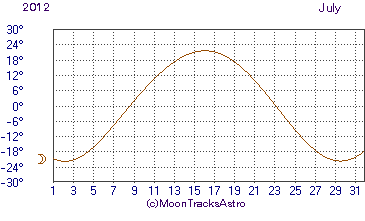

Moon's declination, July 2012

Therefore the moon path is approximately within the range of the sun path, from -23.5° to +23.5° parallel.

For detailed data on lunar declination from 2001-2100, see here.

Lunar Phases and Appearance (Shape) of the Moon 


Appearance of the Moon at the North Pole. The upper part of the diagram is not to scale,
 as the Moon is much farther from the Earth than shown here.(source)

 
At any phase of the moon, the lit portion of the moon indicates the sun's position relative to the moon. The moon moves along a d° small circle of the celestial sphere, where d° is the moon's declination.

At the north pole, the moon's appearance is as shown above, and right (→) is the direction of the moon's advance along the small circle of the celestial sphere. The first quarter moon has the right half lit. The last quarter moon has the left half lit. The moon moves right along a celestial small circle.

Identically with the sun path and star paths, the moon's path (a celestial small circle) occupies a rotated position (from its north polar position) in the sky according to latitude. The first quarter moon's lit half always points to the moon's direction of advance through the night. Likewise the last quarter moon's dark half always points to the moon's direction of advance through the night. (see photos below, possibly taken from space)

At the equator, the first quarter moon rises with top half lit, and sets with the bottom half lit. The last quarter moon rises with the bottom half lit, and sets with the top half lit.

At the south pole the The first quarter moon has the left half lit. The last quarter moon has the right half lit. The moon moves left.


First quarter moon rising (noon, invisible),
or last quarter moon setting (noon, invisible), at the equator


First quarter moon setting (midnight),
or last quarter moon rising (midnight), at the equator


First quarter moon rising (around noon, invisible) at mid Northern hemisphere, or 
last quarter moon setting (around noon, invisible) at mid Southern hemisphere.


First quarter moon setting (around midnight) at mid Northern hemisphere, or 
last quarter moon rising (around midnight) at mid Southern hemisphere.


Last quarter moon rising (around midnight) at mid Northern hemisphere, or 
first quarter moon setting (around midnight) at mid Southern hemisphere.


Last quarter moon setting (around noon, invisible) at mid Northern hemisphere, or 
first quarter moon rising (around noon, invisible) at mid Southern hemisphere.


                       2012 Phases of the Moon
                            Universal Time

        New Moon   First Quarter       Full Moon    Last Quarter    

         d  h  m         d  h  m         d  h  m         d  h  m

                    Jan  1  6 15    Jan  9  7 30    Jan 16  9 08
    Jan 23  7 39    Jan 31  4 10    Feb  7 21 54    Feb 14 17 04
    Feb 21 22 35    Mar  1  1 21    Mar  8  9 39    Mar 15  1 25
    Mar 22 14 37    Mar 30 19 41    Apr  6 19 19    Apr 13 10 50
    Apr 21  7 18    Apr 29  9 57    May  6  3 35    May 12 21 47
    May 20 23 47    May 28 20 16    Jun  4 11 12    Jun 11 10 41
    Jun 19 15 02    Jun 27  3 30    Jul  3 18 52    Jul 11  1 48
    Jul 19  4 24    Jul 26  8 56    Aug  2  3 27    Aug  9 18 55
    Aug 17 15 54    Aug 24 13 54    Aug 31 13 58    Sep  8 13 15
    Sep 16  2 11    Sep 22 19 41    Sep 30  3 19    Oct  8  7 33
    Oct 15 12 02    Oct 22  3 32    Oct 29 19 49    Nov  7  0 36
    Nov 13 22 08    Nov 20 14 31    Nov 28 14 46    Dec  6 15 31
    Dec 13  8 42    Dec 20  5 19    Dec 28 10 21                


Rising and setting of the Moon

The sun is at its upper culmination (highest point in the sky), crossing the observer's meridian, at noon. The new moon is at its upper culmination also at noon (i.e. the moon is then between the sun and the earth). The moon culminates (at its highest point in the sky) at 3 pm at waxing crescent, 6 pm at first quarter, 12 midnight at full moon, and 6 am at last quarter. (see Lunar phase)

At the equator, the moon rises about 6 hours before culmination, and sets about 6 hours after culmination. Elsewhere, the declination of the moon and the observer's latitude determines the exact time of the moon's rising and setting..


Thus, in the following table, the lunar phase determines the moon's meridian passing (upper culmination) time. The moon's declination and latitude  determine the moonrise and moonset azimuth and the meridian passing altitude. The lunar phase, the moon's declination, and latitude determine the moonrise and moonset time.

For similar information on the moon path (and the sun path) at various locations, see here.

Rising and setting times for the Moon. London, July 2012  (source)

All times are in local time for London (BST=UTC+1h)
(table explanation) (Southeast: southeast, East: east,  Southwest: southwest)

Time,localAzimuthMeridian Passing
DateMoonriseMoonsetMoonriseMoonsetTimeAltitudeDistanceIlluminatedPhase
(km)
1 Jul 2012-
19:04
02:27
-
-
126°Southeast
235°Southwest
-
23:1415.9° 362,38995.1%
2 Jul 2012-
20:05
03:23
-
-
126°Southeast
233°Southwest
-
3 Jul 2012-
20:54
04:30
-
-
123°East-southeast
235°Southwest
-
00:1616.4° 363,48599.0%Full Moon at 19:52
4 Jul 2012-
21:32
05:45
-
-
117°East-southeast
239°West-southwest
-
01:1618.4° 366,20499.8%
5 Jul 2012-
22:02
07:04
-
-
111°East-southeast
245°West-southwest
-
02:1421.7° 370,35397.7%
6 Jul 2012-
22:27
08:22
-
-
103°East-southeast
252°West-southwest
-
03:0725.9° 375,56692.9%
7 Jul 2012-
22:49
09:37
-
-
95°East
260°West
-
03:5630.6° 381,36986.1%
8 Jul 2012-
23:09
10:49
-
-
88°East
269°West
-
04:4335.5° 387,25477.7%
9 Jul 2012-
23:29
11:59
-
-
80°East
276°West
-
05:2840.4° 392,75168.3%
10 Jul 2012-
23:50
13:07
-
-
73°East-northeast
284°West-northwest
-
06:1245.0° 397,47358.5%
11 Jul 201214:13291°West-northwest06:5549.2° 401,13848.5%Third Quarter at 02:48
12 Jul 201200:1315:1867°East-northeast296°West-northwest07:4052.8° 403,57138.7%
13 Jul 201200:3916:2162°East-northeast301°West-northwest08:2555.7° 404,70129.5%
14 Jul 201201:1117:2157°East-northeast305°Northwest09:1257.8° 404,56121.0%
15 Jul 201201:4918:1655°Northeast306°Northwest10:0059.0° 403,27713.6%
16 Jul 201202:3419:0454°Northeast306°Northwest10:5059.2° 401,0507.5%
17 Jul 201203:2819:4555°Northeast303°West-northwest11:4058.3° 398,1283.1%
18 Jul 201204:2920:2058°East-northeast299°West-northwest12:3056.3° 394,7600.6%
19 Jul 201205:3620:5063°East-northeast294°West-northwest13:1953.3° 391,1740.3%New Moon at 05:25
20 Jul 201206:4621:1569°East-northeast287°West-northwest14:0849.5° 387,5482.2%
21 Jul 201207:5921:3876°East-northeast280°West14:5544.9° 384,0136.4%
22 Jul 201209:1222:0084°East272°West15:4340.0° 380,65412.9%
23 Jul 201210:2722:2292°East264°West16:3134.9° 377,52321.3%
24 Jul 201211:4422:45101°East256°West-southwest17:2029.8° 374,65931.4%
25 Jul 201213:0123:12109°East-southeast248°West-southwest18:1125.1° 372,10842.7%
26 Jul 201214:1923:43116°East-southeast241°West-southwest19:0521.0° 369,95554.5%First Quarter at 09:56
27 Jul 201215:36-122°East-southeast-20:0218.0° 368,33566.2%
28 Jul 2012-
16:49
00:23
-
-
126°Southeast
237°West-southwest
-
21:0116.3° 367,43177.1%
29 Jul 2012-
17:52
01:12
-
-
126°Southeast
234°Southwest
-
22:0216.1° 367,43986.4%
30 Jul 2012-
18:45
02:13
-
-
125°Southeast
234°Southwest
-
23:0217.4° 368,52293.5%
31 Jul 2012-
19:27
03:23
-
-
120°East-southeast
237°West-southwest
-
23:5920.0° 370,75298.1%

******************************************************
Some sun path diagrams


Equator


London, UK (51.4°N)


Arctic circle


Source: All the following diagrams are from here, where you can specify the location and date of the sun path you want.

Sun path at Qanaq (Qaanaaq), Greenland (77°29′00″N, above the Arctic Circle) at summer solstice


Sun path at Trondheim (63°25′N, just below the Arctic Circle) at summer solstice

Sun path at Hong Kong (22°19′N, near Tropic of Cancer) at summer solstice


Sun path at Quito (near the Equator, 0°13′S) at March equinox

Sun path at Quito (near the Equator, 0°13′S) at June solstice

Sun path at Bangkok, Thailand (13°55′N) at June solstice


Sun path at Bangkok, Thailand (13°55′N) at December solstice


Why does the setting waxing crescent moon appear more horizontal (seem to smile more) in winter than in summer in the Northern hemisphere?

A reader of this post has asked about the phenomenon that the waxing crescent moon (following the new moon), when observed setting in the west in mid-northern latitudes, appears to be more horizontal (like a smile) in winter than in summer.

A common, but wrong, interpretation is that the moon path in winter is different from that in summer, as shown in this diagram:


Wrong picture! 

There is absolutely no reason why the moon path should differ in this manner.

The moon path intercepts the western  horizon at exactly the same angle (given any fixed latitude) at all times of the year. 

The following is the right picture, showing that the crescent moon tilts but the moon path remains the same:


The explanation of this tilt is as follows:

For background knowledge, first read the section above on Lunar Phases and Appearance (Shape) of the Moon.


Appearance of the Moon at the North Pole


For the Moon to appear (called the standard appearance) as shown in the above diagram, a specific relation (called the special configuration) on the positions of the earth, the moon and the sun must hold.

You may skip the following description of the special configuration, the understanding of which requires some careful thought.

*****************************************
Special Configuration

Consider an observer K of the Moon on Earth's North Pole. The boundary C of the Moon's observable hemisphere (assuming full moon) is a great circle. Let's impose circles of longitude (meridians) on the moon thus: Let the top and bottom of the Moon (on C) as seen by K be the Moon's poles. A Moon's meridian is a great circle, such as C, that contains both poles.

For the Moon to appear as shown above with the standard appearance, the boundary of the Moon's Sun-illuminated hemisphere must be a meridian.

This in turn implies that the Sun must lie on the Moon's Equatorial plane (the plane normal to its polar axis and containing its center). This is the special configuration mentioned above.

*******************************************

Near the June solstice, the sun's declination is high (near +23.5°). Thus it is probable the the sun's declination is higher than what the special configuration requires, which in turn causes the moon shape as seen in the North Pole to tilt in the following manner compared with the standard appearance because the sun now illuminates a different portion of the moon.

Shape of first quarter moon (tilt exaggerated) at North Pole  


Near the December solstice, the sun's declination is low (near -23.5°). Thus it is probable the the sun's declination is lower than what the special configuration requires, which in turn causes the moon shape as seen in the North Pole to tilt in the following manner compared with the standard appearance because the sun now illuminates a different portion of the moon.

Shape of first quarter moon (tilt exaggerated) at North Pole


The moon shape seen at any latitude likewise tilts (see the section above on Lunar Phases and Appearance (Shape) of the Moon for how latitude determines moon shape).


This explains why the waxing crescent moon, when setting in the northern hemisphere, probably smiles more in winter than in summer.


***************************************

The following table gives the approximate data on the Moon's declination, the Sun's declination as required by the special configuration (A), the Sun's actual declination (B), and their difference (B-A), two days after the new moons (i.e. at the first observable waxing crescent moon) in 2015. 

The sun's deviation from its special configuration is 11.49° on 7/18/2015, and -13.94° on 2/21/2015, making a total deviation of 25.43°.  This is certainly noticeable, and explains the above mentioned shift in moon shape.


Datemoon's declinationA. special configB. sun's declinationB-A
1/22/2015-8.40-7.65-19.87-12.22
2/21/20153.373.07-10.87-13.94
3/22/20159.989.080.40-8.68
4/21/201517.1515.5811.65-3.93
5/20/201518.3816.6919.853.16
6/18/201517.0815.5123.407.89
7/18/201510.609.6421.1311.49
8/16/20154.834.4013.939.53
9/15/2015-5.13-4.673.277.94
10/15/2015-13.73-12.48-8.304.18
11/14/2015-18.20-16.53-18.07-1.54
12/13/2015-17.77-16.14-23.12-6.98


The sun's pattern of deviation from its special configuration varies from year to year. The maximum declination of the moon plays an important role in the pattern.

October 2015 sees a minor lunar standstill, when the moon's maximum declination is at its minimum.

The following tabulates the same set of data for 2006. In June 2006 there was a major lunar standstill, when the moon's maximum declination is at its maximum.


Datemoon's declinationA. special configB. sun's declinationB-A
1/2/2006-24.23-21.95-22.85-0.90
1/31/2006-18.12-16.45-17.63-1.18
3/2/2006-6.33-5.76-7.87-2.11
3/31/20067.576.893.62-3.27
4/30/200620.5018.6014.20-4.40
5/29/200628.4925.7521.50-4.25
6/28/200624.5222.2123.120.91
7/27/200619.9018.0619.451.39
8/26/20069.538.6711.072.40
9/24/2006-3.85-3.510.033.54
10/24/2006-17.50-15.89-11.224.67
11/23/2006-28.44-25.70-20.035.67
12/22/2006-24.52-22.21-23.50-1.29


The largest positive deviation of the sun's declination (5.67°) in 2006 occurred near the December solstice, and the largest negative deviation of the sun's declination (-4.40°) in 2006 occurred near the June solstice. The magnitude of the deviations were small throughout the year. 

The above mentioned shift in crescent moon shape is therefore not an unchanging phenomenon observable every year.


* For computing column A. above, I used the geometry and trigonometry here.


   *******************************************************************

Wednesday, March 7, 2012

Synchronicity of strong monarchs: Louis XIV, Aurangzeb, Kangxi, and Peter the Great

Isaac Asimov in his Chronology of the World (1991) pointed out the remarkable simultaneous rules of the following four strong, influential, and long-reigning (lasting at least 42 years) monarchs in the late 17th century:


Louis XIV of France, reigned 14 May 1643 – 1 September 1715  (&1000000000000007200000072 years, &10000000000000110000000110 days)

Aurangzeb, Mughal emperor (of India), reigned 31 July 1658 – 3 March 1707  (&1000000000000004800000048 years, &10000000000000215000000215 days)

Kangxi Emperor (康熙) of China (Qing dynasty), reigned 5 February 1661 – 20 December 1722 (&1000000000000006100000061 years, &10000000000000318000000318 days)

Peter the Great of Russia, reigned 7 May 1682 – 8 February 1725 (&1000000000000004200000042 years, &10000000000000277000000277 days)

For almost twenty-five years, 7 May 1682 - 3 March 1707, all four were sovereigns on the world stage.

Contemporaneous with these four heavyweights is the lightweight but enduring Frederick William, the Great Elector, of Brandenburg-Prussia, who reigned 1 December 1640 – 29 April 1688 (47 years, 150 days).

Other synchronous long reigns of note that I have observed are, in order of their inception:

16th century

Henry VIII of England, reigned 21 April 1509 – 28 January 1547 (&1000000000000003700000037 years, &10000000000000282000000282 days)

Francis I of France, reigned 1 January 1515 – 31 March 1547 (&1000000000000003200000032 years, &1000000000000008900000089 days)

Charles I of Spain, reigned 23 January 1516 – 16 January 1556 (39 years, 358 days)

Suleiman the Magnificent, Ottoman sultan, reigned 30 September 1520 - 6/7 September 1566 (45 years, 342 days)

Ivan the Terrible of Russia, reigned  3 December 1533 – 28 March 1584 (50 years, 116 days)

Philip II of Spain, reigned 16 January 1556 – 13 September 1598 (42 years, 240 days)

Akbar the Great, Mughal emperor (of India), reigned 14 February 1556 - 27 October 1605 (49 years, 255 days)


Elizabeth I of England, reigned 17 November 1558 – 24 March 1603 (44 years, 127 days)

James VI of Scotland, James I of England, reigned (in Scotland) 24 July 1567 – 27 March 1625 (57 years, 246 days)

Wanli Emperor (万历) of China (Ming dynasty), reigned 19 July 1572 – 18 August 1620 (&1000000000000004800000048 years, &1000000000000003000000030 days)

Rudolf II of the Holy Roman Empire (House of Habsburg), reigned 12 October 1576 – 20 January 1612 (35 years, 100 days)

Shah Abbas the Great of Persia (Safavid dynasty), reigned 1 October 1587 - 19 January 1629 (&1000000000000004100000041 years, &10000000000000110000000110 days)

Christian IV of Denmark-Norway, reigned 4 April 1588 – 28 February 1648 (59 nyears, 329 days)


**The following long-reigning 16th century monarchs are relatively obscure:

John III of Portugal, reigned 13 December 1521—11 June 1557 (35 years, 180 days)

Gustav I of Sweden, reigned 6 June 1523 – 29 September 1560 (&1000000000000003700000037 years, &10000000000000115000000115 days)


Sultan Ibrahim Adil Shah II of Bijapur, reigned 1580 – 12 September 1627 (46/47 years)

Sigismund III Vasa of Poland-Lithuania, reigned 18 September 1587 – 19 April 1632 (44 years, 214 days)

__________________

During the period 4 April 1588 – 13 September 1598, the following were contemporaneous reigning monarchs:  Philip II of Spain, Akbar the Great, Elizabeth I of England, James VI of Scotland, Wanli Emperor, Rudolf II of the Holy Roman Empire, Shah Abbas the Great of Persia, Christian IV of Denmark-Norway, Sigismund III Vasa of Poland-Lithuania, Sultan Ibrahim Adil Shah II of Bijapur.


**********************

18th century

Louis XV of France, reigned 1 September 1715 – 10 May 1774 (&1000000000000005800000058 years, &10000000000000251000000251 days)

Qianlong Emperor (乾隆) of China (Qing dynasty), reigned 8 October 1735 – 7 February 1799 (&1000000000000006300000063 years, &10000000000000122000000122 days)


Frederick the Great of Prussia, reigned 31 May 1740 – 17 August 1786 (&1000000000000004600000046 years, &1000000000000007800000078 days)

Maria Theresa, archduchess of Austria, reigned 20 October 1740 – 29 November 1780 (&1000000000000004000000040 years, &1000000000000004000000040 days)

George III of the United Kingdom, reigned 25 October 1760 – 29 January 1820 (59 years, 96 days)

Catherine the Great of Russia, reigned 9 July 1762 – 17 November 1796 (&1000000000000003400000034 years, &10000000000000131000000131 days)


********************

19th century

Queen Victoria of the United Kingdom, reigned 20 June 1837 – 22 January 1901 (63 years,  216 days)

Franz Joseph I of Austria, reigned 2 December 1848 – 21 November 1916 (67 years, 355 days)

Empress Dowager Cixi (慈禧太后) of China (Qing dynasty), reigned as regent 11 November 1861 – 15 November 1908 (&1000000000000004700000047 years, &100000000000000040000004 days)

Louis XIV

Aurangzeb


Kangxi


Peter the Great


An excellent companion to Asimov's Chronology of the World is his concise The March of the Millennia: A key to looking at history (1991, co-authored with Frank White).


Thursday, February 23, 2012

Why Gödel induced no despair among mathematicians

The Hilbert program aims to formalize (axiomatize) all mathematics on a secure core foundation of “finitistic” (excluding infinite sets, etc) mathematics whose “truth” is beyond all doubt.


Gödel's incompleteness theorems prove that any such formalization that is powerful enough to embed (encode) Peano arithmetic is incomplete (i.e. there is a statement of Peano arithmetic that can neither be proved nor disproved). This shows the impossibility of the Hilbert program, and is said to have induced a “crisis” in the foundation of mathematics.

Despite the occasional sensational claim that Gödel's incompleteness theorems in effect destroyed both the mathematical enterprise, and society’s and scientists’ faith in mathematics, mathematics has in fact progressed apace since 1931.

Other than logicians and theoretical computer scientists, mathematicians are, in general, blissfully uneducated in Gödel's incompleteness theorems. An algebraist or a topologist would happily pursue her/his research without any regard to the foundational “crisis“. Far from being disillusioned, mathematicians are as motivated and enthusiastic as ever.

Why?

Case 1

If one is trying to prove or diaprove a statement M in a theory T (such as
set theory), that is powerful enough to embed Peano arithmetic, then, as T is incomplete (as proved by Gödel), there are statements S in T such that both S and (not S) are not provable. M  may be just such a statement. If so, trying to prove or disprove M is doomed to fail.

This then is the extent of one’s psychological “crisis” induced by the foundational “crisis“.

However, even if the theory were complete, so that either M or (not M) is provable, proving either may well be beyond one‘s intellect. I would contend that knowing that the theory is complete does not make one's attempt to prove either M on (not M) any easier or reassuring.

Case 2


If one is working on a theory incapable of embedding Peano arithmetic, then the theory may in fact be complete, and perhaps there is no crisis at all.

Some examples of such complete theories are Presburger arithmetic , Tarski's axioms for Euclidean geometry , the theory of dense linear orders, the theory of algebraically closed fields of a given characteristic, the theory of real closed fields , every uncountably categorical countable theory, and every countably categorical countable theory. (see Complete theory)

In general, Gödel makes no practical difference to a research mathematician. Mathematics has continued to develop despite the failure of the over-ambitious Hilbert program.

For the less ambitious successors to the Hilbert program, see
Wikipedia and Partial Realizations of Hilbert’s Programs, by Stephen G. Simpson.

(For a brief introduction to mathematical logic, and the foundation of mathematics, see Logic and Mathematics, by Stephen G. Simpson.)


Sunday, January 15, 2012

Understanding the Sufis with William Dalrymple (video)

William Dalrymple (Wikipedia) (born 1965) is a remarkable scholar and traveller.

I first knew of him through his excellent travel book In Xanadu (1989), recounting a journey he undertook in 1986, during his second summer as an undergraduate (senior history scholar) reading history at Trinity College, Cambridge, that retraced the path taken by Marco Polo from the Church of the Holy Sepulchre in Jerusalem to the site of Shangdu, famed as Xanadu in English literature, in Inner Mongolia, China.

From the Wikipedia article on Dalrymple:

"Dalrymple has lived in India on and off since 1989 and spends most of the year at his farmhouse in the outskirts of Delhi, but summers in London and Edinburgh.

"Dalrymple's interests include India, Pakistan, Afghanistan, the Middle East, Mughal rule, the Muslim world, Hinduism, Buddhism, the Jains and early Eastern Christianity.

"All of his seven books have won major literary prizes, as have his radio and television documentaries. His first three books were travel books based on his journeys in the Middle East, India and Central Asia. His early influences included the travel writers such as Robert Byron, Eric Newby, and Bruce Chatwin. More recently, Dalrymple has published a book of essays about South Asia, and two award-winning histories of the interaction between the British and the Mughals between the eighteenth and mid nineteenth century. His books have been translated into more than 30 languages."

********************************

I just came across Dalrymple's excellent 2005 TV documentary, Sufi Soul, that investigates Sufi music and spirituality (in Syria, Turkey, Morocco, Pakistan, and India), a subject that has received scant attention in the West. For me, it has opened a new door onto a fascinating vista.

Sufi Soul (High video quality. No subtitle)


Another copy of Sufi Soul (of lower quality, with English subtitle)


Tuesday, January 3, 2012

Ivan Sytin: A Russian better known in Chinese than in English


I just bought a book entitled "为书籍的一生" ("My Life for the Book", here (in Chinese); Жизнь для книги), a re-printed 1963 Chinese (mainland) translation of the memoirs of Ivan Dmitrievich Sytin (Иван Дмитриевич Сытин (Russian Wikipedia article, with good Google translation), 绥青), a prominent Russian publisher in the era immediately preceding the Russian Revolution of 1917.

"Through sharp and unremittingly ironic observations, Sytin describes with insight and amusement or dismay Tsarist Russia's bureaucracy, the Orthodox Church, the Imperial court, and a number of the country's most renowned writers, including Anton Chekhov, Leo Tolstoy, Maxim Gorky, and journalist Vlas Doroshevich."

"Sytin's memoir, a tale of Great Russian society voiced by a parvenu, depicts a pre-Revolutionary Russia of small shops, churches, convents, deep religious faith, and flawed rulers. While the Revolution eventually deprived Sytin of all means to continuing publishing, his resilience and enterprise remain a lasting legacy."

It appears that Sytin's memoirs has not been translated into English (a English translation is due for publication in June 2012), and is little known in English.

A reliable indicator of Sytin's obscurity among the Anglophones is the absence of an English Wikipedia article on him.


Sytin is therefore a rare instance of a notable Western figure whom I would not have known about were I not literate in Chinese.

Russian Entrepreneur: Publisher Ivan Sytin of Moscow, 1851-1934
Ruud, Charles A. (1990). Russian Entrepreneur: Publisher Ivan Sytin of Moscow, 1851 - 1934. Montreal: McGill-Queen's University Press (amazon)


************************************************

(source)

Ivan Dmitrievich Sytin (24 January (5 February) 1851 - 23 November 1934), Russia's leading pre-Revolution publisher of books, magazines, and the top daily newspaper, Russian Word (Russkoye slovo).

Ivan Dmitrievich Sytin, had literate but poor peasant parents and only two years of schooling in his native village of Gnezdnikovo, Kostroma Province. Venturing first to the Nizhny Novgorod Fair at fourteen as helper to a fur-trading uncle, he apprenticed at fifteen to a Moscow printer-merchant who helped him start a business in 1876, the year of his marriage to a cook's daughter who would be vital to his success.

Like his mentor, Sytin issued calendars, posters, and tales that itinerant peddlers sold to peasants throughout the countryside. When in 1884 Leo Tolstoy needed a publisher for his simple books (the Mediator series) meant to edify the same readership, his choice of Sytin raised this unknown to respected status among intellectuals. Sytin then began to publish for well-educated readers and branched into schoolbooks, children's books, and encyclopedias by investing in the new mass-production German presses that cut per-unit costs. His rise as an entrepreneur who exploited the latest technology led contemporaries to tag him "American" in method.

Sytin claimed that he became a newspaper publisher in 1894 at Anton Chekhov's urging, and he hired able editors and journalists who made his Russian Word the most-read liberal daily in Russia. Lessening censorship and rapid industrialization in the last decades of the tsarist regime helped Sytin add to his publishing ventures and kept him a millionaire through the economic disruption of World War I. After the 1917 Revolution, Sytin received assurances from Vladimir Lenin that he could publish for the Bolshevik regime, only to be cast off as a capitalist after Lenin died in 1924. The final decade of his life was marked by gloom, austerity, and obscurity, offset only by his church attendance and his writing of memoirs (published in the USSR in 1960 in a shortened edition). His downtown Moscow apartment is today an exhibition center in his honor.

Bibliography

Lindstrom, Thaïs. (1957). "From Chapbooks to Classics: The Story of Intermediary." American Slavic and East European Review 16:190 - 201.

Ruud, Charles A. (1990). Russian Entrepreneur: Publisher Ivan Sytin of Moscow, 1851 - 1934. Montreal: McGill-Queen's University Press.

Watstein, J. (1971). "Ivan Sytin - An Old Russian Success Story." Russian Review 30:43 - 53. (first page)


*************************************
(source)

Ivan Sytin was called a person of rare gifts. He came from a peasant family, and his only legacy was his father's blessing. At the age of 14 he came to Moscow to make a success of his life. Sytin began with joining the book shop of merchant Sharapov. “I was tall and sturdy. I could do any kind of work,” said Sytin later. “My duties were to clean my boss's shoes, lay the table for shop-assistants, bring food for them; in the morning I had to bring water and firewood to the house, buy provisions at the market. I did everything honestly, neatly and on time”.

Soon the boss came to appreciate the efforts of the bright and zealous teenager, and appointed him his own valet. He fostered the love for reading in him. At first Sytin read religious books, then the boss began to give him rare editions. For Sharapov book trade was an accidental undertaking, and so he knew little about it, relying mostly on his assistants.

As a result of ten years of assiduous work Sytin acquired extensive experience and earned some money. With the help of his master he opened a small lithographic business, which paved the way for an enormous book and magazine publishing enterprise. When he worked at Sharapov's shop he listened to tradesmen's stories and came to the conclusion that ordinary people needed good books whose value was accessible to them. That is why he began his undertaking with printing books by the famous Russian novelists Anton Chekhov, Leo Tolstoy, Alexander Pushkin and others. Inexpensive and well published, his books were in great demand. In addition Sytin began to print the “Popular Calendar”, a kind of handy encyclopedia that found its way to virtually every Russian family. By printing inexpensive but necessary edition he defeated his competitors and soon became the boss of Russia's book publication. For Sytin commerce was a means, not a goal. However, as an entrepreneur he had to abide by the laws of the book market with its free prices and competition. To compensate for the publication of inexpensive books Sytin printed costly editions, such as encyclopedias in luxury book covers meant for well-to-do people.

The success of Sytin's enterprise was based not only on his business grasp and willingness to take the risks, but also on his use of advanced printing equipment and ability to organize an excellent system of marketing.

His dream was to build near Moscow a publishing town equipped with the latest machinery, with excellent houses for the workers, with schools, hospitals and theaters, all in the name of books.

However that dream was not to come true. After the 1917 Bolshevik Revolution his publishing house was nationalized and Sytin lost his business. His attempts to engage in publishing books under the Soviet government ended in failure. The last years of his life he in poverty and obscurity. Sytin died in 1934. However history has preserved the memory of the man who did so much to promote enlightenment in Russia.

Monday, January 2, 2012

The Joy of Quiet: Pico Iyer


The joy of quiet

As our lives become more hectic, the need to slow down becomes more urgent

About a year ago, I flew to Singapore to join the writer Malcolm Gladwell, the fashion designer Marc Ecko and the graphic designer Stefan Sagmeister in addressing a group of advertising people on "Marketing to the Child of Tomorrow".

Soon after I arrived, the chief executive of the agency that had invited us took me aside. What he was most interested in, he began - I braced myself for mention of some next-generation stealth campaign - was stillness.

A few months later, I read an interview with the perennially cutting-edge designer Philippe Starck. What allowed him to remain so consistently ahead of the curve? "I never read any magazines or watch TV," he said, perhaps a little hyperbolically. "Nor do I go to cocktail parties, dinners or anything like that." He lived outside conventional ideas, he implied, because "I live alone mostly, in the middle of nowhere".

Around the same time, I noticed that those who part with US$2,285 (S$2,965) a night to stay in a cliff-top room at the Post Ranch Inn in Big Sur pay partly for the privilege of not having a TV in their rooms; the future of travel, I'm reliably told, lies in "black-hole resorts", which charge high prices precisely because you can't get online in their rooms.

Has it really come to this?

In barely one generation we've moved from exulting in the time-saving devices that have so expanded our lives to trying to get away from them - often in order to make more time.

The more ways we have to connect, the more many of us seem desperate to unplug. Like teenagers, we appear to have gone from knowing nothing about the world to knowing too much all but overnight.

Internet rescue camps in South Korea and China try to save kids addicted to the screen. Writer friends of mine pay good money to get the Freedom software that enables them to disable (for up to eight hours) the very Internet connections that seemed so emancipating not long ago.

Even Intel (of all companies) experimented in 2007 with conferring four uninterrupted hours of quiet time every Tuesday morning on 300 engineers and managers. (The average office worker today, researchers have found, enjoys no more than three minutes at a time at his or her desk without interruption.) During this period the workers were not allowed to use the phone or send email, but simply had the chance to clear their heads and to hear themselves think. A majority of Intel's trial group recommended that the policy be extended to others.


URGENCY OF SLOWING DOWN

The average American spends at least eight-and-a-half hours a day in front of a screen, Nicholas Carr notes in his eye-opening book The Shallows, in part because the number of hours American adults spent online doubled between 2005 and 2009 (and the number of hours spent in front of a television screen, often simultaneously, is also steadily increasing).

The average American teenager sends or receives 75 text messages a day, though one girl in Sacramento managed to handle an average of 10,000 every 24 hours for a month. Since luxury, as any economist will tell you, is a function of scarcity, the children of tomorrow, I heard myself tell the marketers in Singapore, will crave nothing more than freedom, if only for a short while, from all the blinking machines, streaming videos and scrolling headlines that leave them feeling empty and too full all at once.

The urgency of slowing down - to find the time and space to think - is nothing new, of course, and wiser souls have always reminded us that the more attention we pay to the moment, the less time and energy we have to place it in some larger context.

"Distraction is the only thing that consoles us for our miseries," the French philosopher Blaise Pascal wrote in the 17th century, "and yet it is itself the greatest of our miseries." He also famously remarked that all of man's problems come from his inability to sit quietly in a room alone.

When telegraphs and trains brought in the idea that convenience was more important than content - and speedier means could make up for unimproved ends - Henry David Thoreau reminded us that "the man whose horse trots a mile in a minute does not carry the most important messages".

Even half a century ago, Marshall McLuhan, who came closer than most to seeing what was coming, warned, "When things come at you very fast, naturally you lose touch with yourself." Thomas Merton struck a chord with millions, by not just noting that "Man was made for the highest activity, which is, in fact, his rest", but by also acting on it, and stepping out of the rat race and into a Cistercian cloister.


LESS AND LESS TO SAY

Yet few of those voices can be heard these days, precisely because "breaking news" is coming through (perpetually) on CNN and Debbie is just posting images of her summer vacation and the phone is ringing. We barely have enough time to see how little time we have (most Web pages, researchers find, are visited for 10 seconds or less).

And the more that floods in on us (the Kardashians, Obamacare, Dancing with the Stars), the less of ourselves we have to give to every snippet. All we notice is that the distinctions that used to guide and steady us - between Sunday and Monday, public and private, here and there - are gone.

We have more and more ways to communicate, as Thoreau noted, but less and less to say. Partly because we're so busy communicating. And - as he might also have said - we're rushing to meet so many deadlines that we hardly register that what we need most are lifelines.

So what to do? The central paradox of the machines that have made our lives so much brighter, quicker, longer and healthier is that they cannot teach us how to make the best use of them; the information revolution came without an instruction manual.

All the data in the world cannot teach us how to sift through data; images don't show us how to process images. The only way to do justice to our onscreen lives is by summoning exactly the emotional and moral clarity that can't be found on any screen.

'INTERNET SABBATH'

Maybe that's why more and more people I know, even if they have no religious commitment, seem to be turning to yoga, or meditation, or tai chi; these aren't New Age fads so much as ways to connect with what could be called the wisdom of old age.

Two journalist friends of mine observe an "Internet sabbath" every week, turning off their online connections from Friday night to Monday morning, so as to try to revive those ancient customs known as family meals and conversation. Finding myself at breakfast with a group of lawyers in Oxford four months ago, I noticed that all their talk was of sailing - or riding or bridge: Anything that would allow them to get out of radio contact for a few hours.

Other friends try to go on long walks every Sunday, or to "forget" their mobile phones at home. A series of tests in recent years has shown, Mr Carr points out, that after spending time in quiet rural settings, subjects "exhibit greater attentiveness, stronger memory and generally improved cognition. Their brains become both calmer and sharper".

More than that, empathy, as well as deep thought, depends (as neuroscientists like Antonio Damasio have found) on neural processes that are "inherently slow". The very ones our high-speed lives have little time for.


BENEFIT OF DISTANCE

In my own case, I turn to eccentric and often extreme measures to try to keep my sanity and ensure that I have time to do nothing at all (which is the only time when I can see what I should be doing the rest of the time).

I've yet to use a mobile phone and I've never Tweeted or entered Facebook. I try not to go online till my day's writing is finished, and I moved from Manhattan to rural Japan in part so I could more easily survive for long stretches entirely on foot, and every trip to the movies would be an event.

None of this is a matter of principle or asceticism; it's just pure selfishness. Nothing makes me feel better - calmer, clearer and happier - than being in one place, absorbed in a book, a conversation, a piece of music. It's actually something deeper than mere happiness: It's joy, which the monk David Steindl-Rast describes as "that kind of happiness that doesn't depend on what happens".

It's vital, of course, to stay in touch with the world, and to know what's going on; I took pains this past year to make separate trips to Jerusalem and Hyderabad and Oman and St Petersburg, to rural Arkansas and Thailand and the stricken nuclear plant in Fukushima and Dubai. But it's only by having some distance from the world that you can see it whole, and understand what you should be doing with it.
For more than 20 years, therefore, I've been going several times a year - often for no longer than three days - to a Benedictine hermitage, 40 minutes down the road, as it happens, from the Post Ranch Inn. I don't attend services when I'm there, and I've never meditated, there or anywhere; I just take walks and read and lose myself in the stillness, recalling that it's only by stepping briefly away from my wife and bosses and friends that I'll have anything useful to bring to them.

The last time I was in the hermitage, three months ago, I happened to pass, on the monastery road, a youngish-looking man with a three-year-old around his shoulders.

"You're Pico, aren't you?" the man said, and introduced himself as Larry; we'd met, I gathered, 19 years before, when he'd been living in the cloister as an assistant to one of the monks.

"What are you doing now?" I asked.

"I work for MTV. Down in LA."

We smiled. No words were necessary.

"I try to bring my kids here as often as I can," he went on, as he looked out at the great blue expanse of the Pacific on one side of us, the high, brown hills of the Central Coast on the other. "My oldest son" - he pointed at a seven-year-old running along the deserted, radiant mountain road in front of his mother - "this is his third time".

The child of tomorrow, I realised, may actually be ahead of us, in terms of sensing not what's new, but what's essential.

Pico Iyer is the author, most recently of The Man Within My Head.